

Spend as much time as I do on a college or university campus, and you soon realize an interesting fact about campus spiritual life. The offer of “free pizza” by various campus ministries is a sure sign that new students (in some place still referred to as “freshmen”), are now on campus. Free pizza, gift certificates for a fast food chicken sandwich, and the offer of fellowship (by which is meant a certain, superficial friendship Aristotle would have described as one of utility), are all the currency used by (primarily, but by no means exclusively) Evangelical Christians to attract students to their programs.
The often overlooked irony here, is that this is largely the approach taken by the college or university’s office of student services. Free food and friendships of utility.
Neither of these, let me hasten to add, are in and of themselves, immoral or manipulative. A shared meal, or in the case of free pizza, what passes for a meal, is often the first step in what can become a life-long friendship. Consider this:
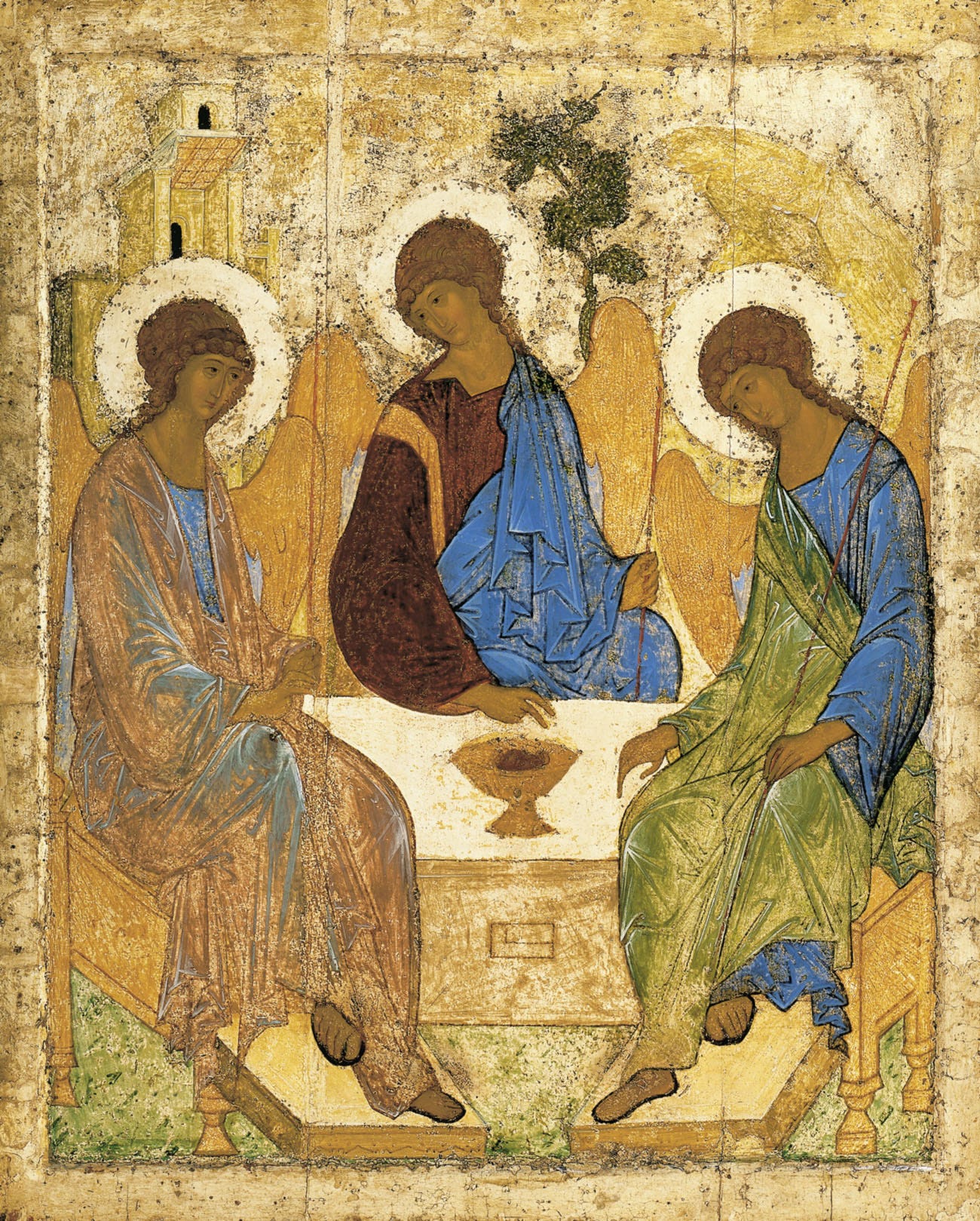
According to the biblical account, it is with a meal at the Oak of Mamre (Genesis 18:1–8), that the Most Holy Trinity is revealed and enters into what will be a lifelong friendship with humanity beginning with Abraham.
Nor should we dismiss friendships based in utility anymore than we should dismiss the first stirring of physical attract that will one day grow into a mature, conjugal love. After all, to borrow from T.S. Eliot, in our ends we find our beginnings.
But an academic community, or so it seems to me, must offer more than free pizza and easy fellowship. A college or university worthy of its own, deep history in the Gospel and Eucharistic life of the Church (East and West, Greek and Latin), must offer ideas that challenge, inspire, and transform. They must offer truth.
A Christian ministry especially must take seriously this challenge to not only offer truth (and the Truth, Who is Christ) but do so in a manner that takes the consumers of ideas and reforms and transforms them into witnesses for truth and the Truth.
On this point, we have the Greek word μάρτυς (martus), from which we derive the word “martyr.” Few things mitigate against martyrdom more than “free pizza,” easy fellowship, and the glib self-assured answers that are the conversational currency on most campuses.
In saying this, let me once again hasten to add, I am not criticizing the students. Rather, I am looking at the adults, those of us who have taken on the obligation to guide them. It is with more than a note of irony that for all that they disagree, conservative campus voices (religious and secular) and progressive offices of student affairs, share a common, rhetorical approach rooted not in metaphysical, ontology, and ethics but sociology and psychology. The arguments between these two groups are so intense, if I may wax cliché, because the stakes are so low.
No one has ever died for a disagreement rooted in the social sciences. Though, as recent events demonstrate, there are those on both sides willing to kill or at least bless the killing.
And so, “No Free Pizza.” A series of six, short lectures on the spirituality of the Orthodox Church. The first of these asks the listener to reflect on the only two questions that matter:
Why is there something, rather than nothing?
What are you going to do about it?
The spirituality of the Orthodox Church are built on the answers to these questions. To find answers to these questions, we turn to the 7th century monk, St. Maximus the Confessor. What I especially like about St. Maximus is his argument that Christ’s incarnation was not a reaction to sin, but God’s original plan to unite all creation. And us? St. Maximus says that humanity, is a “microcosm,” and called by God to unite five fundamental dimensions of reality. Thankfully, while we failed, Christ succeeded in unifying the cosmos in his person. The life of the Church is nothing more or less, than our experiencing in our own life, Christ’s communion with the cosmos or deification (theosis).


